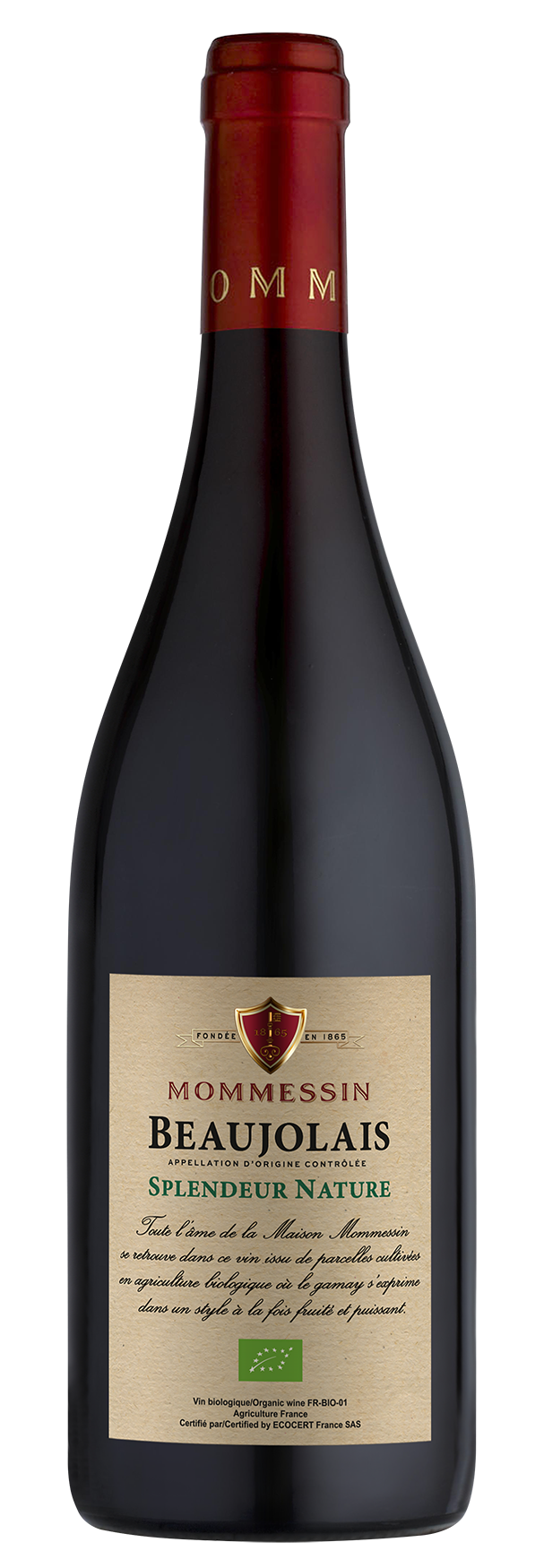
BEAUJOLAIS BIO 2025
Grape varietal
Gamay.
Tasting notes
Colour: Beautiful, intense ruby colour.
Nose: The bouquet is equally intense, offering subtle, varied aromas of red fruit.
Palate: A fine, elegant wine that reveals a wide range of crisp fruit flavours and tremendous freshness.
Serving suggestions
Serve at a temperature of 13-14°C. (55-57°F).
Food and wine pairing
May be enjoyed simply as an aperitif, accompanied by a selection of local charcuterie or a home-made country terrine, or during a meal, accompanied by white meat, grilled food, vegetarian cuisine, savoury tarts, pasta dishes or a lightly seasoned pizza. It also goes very well with mature cheeses.
Ageing potential
Already very pleasant, this Beaujolais can easily be cellared for up to five years.
Origins
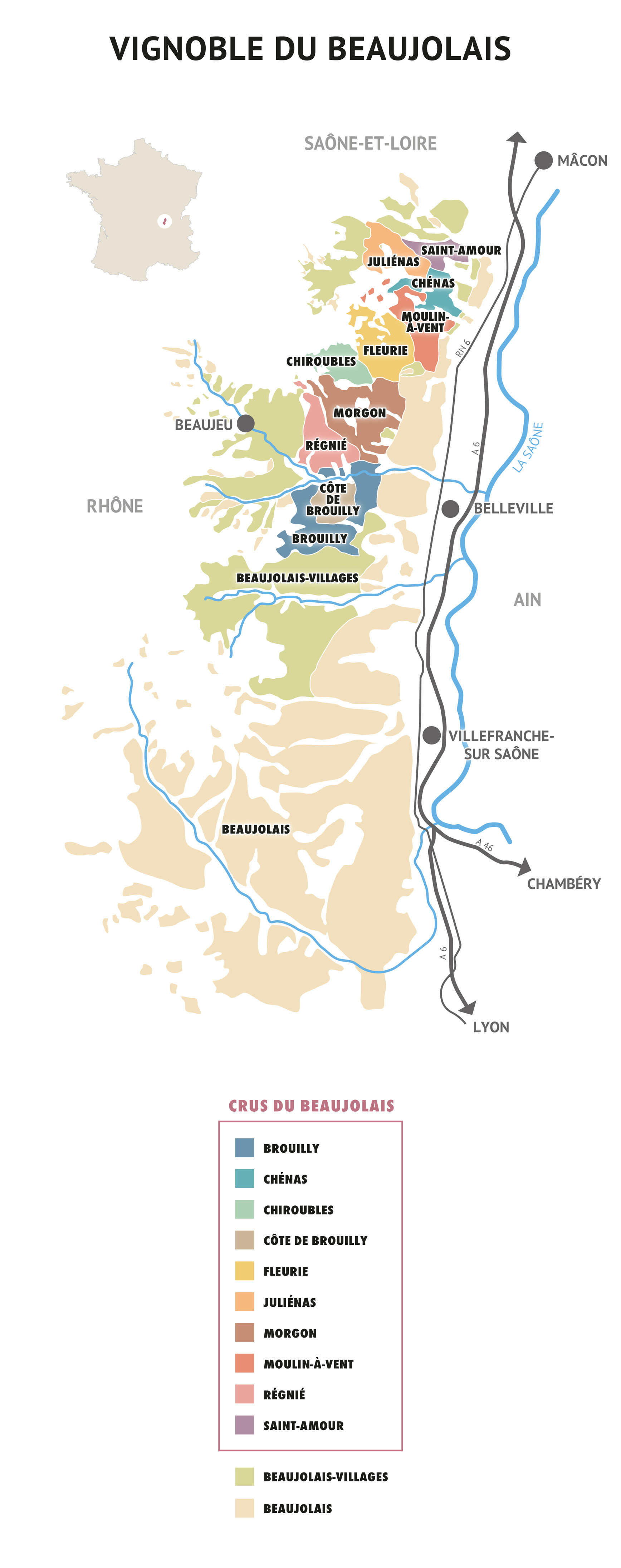
The Beaujolais appellation essentially groups together wines from the region located south of Villefranche-sur-Saône. The vineyards vary enormously, extending over 9,700 hectares overlooking the Saône plain between Mâcon and Lyon and bordered to the west by the foothills of the Massif Central.
Terroir
Our wine is made from organically grown Gamay grapes from three different plots.
Two of these consist of mainly hard limestone soil and marl slopes covered with scree with some rows of vines planted on residual clay with pieces of chert.
The vines on the third plot are planted mainly on granite with some on siliceous volcanic rock and on schist or bluish rock.
Vine and soil
- Planting density: 8,000-10,000 vines/ha
- Average age of the vines: 45 years old.
- Yield: 30hl/ha.
- Pruning: Cordon or Single Guyot.
- Vineyard management: organic agriculture.
Everything is carefully analysed: the threat of diseases, the numbers of insect pests and auxiliaries present in the plots’ agro-system, the size and number of bunches, the effect of weeds, the state of the vines’ foliage, etc.
Soil management: decavaillonnage (turning over the soil around the base of each vine), light ploughing, work between the vines.
This approach meets two objectives:
- restoring the physiological balance of the vines, the soil and the terroir,
- protection and respect of the environment.
Vinification and maturing
The Gamay grapes were sorted out in the vineyard and then, once again, at the arrival at the winery. Most of the grapes were destemmed and macerated for 8-10 days.
There are also wines produced in the traditional Beaujolais style in the blend, with semi-carbonic maceration from 5 to 8 days. This wine was aged on fine lees in stainless steel and concrete vats.
Vintage : 2025
In the Beaujolais area, the 2025 vintage stands out for its remarkable precocity, in line with great sunny years such as 2015 and 2018. After a fairly cool winter and a balanced spring, budbreak occurred as early as April 6, followed by a rapid flowering at the end of May, eight days ahead of 2024.
Early summer was marked by contrasts: heavy rainfall in early June, locally accompanied by hail, was followed by a sharp rise in temperatures. A more moderate July preceded a heatwave in August, with peaks above 40°C. (104° F.), leading to significant water stress.
These conditions accelerated ripening, enhanced berry concentration and kept disease pressure extremely low. Harvest began on August 23 for Chardonnay and August 25 for Gamay, extending until September 16 depending on the area.
Despite reduced volumes due to hail and drought, quality is definitely there: concentrated, complex wines with deep color and solid tannic structure. A truly nice vintage in the making.
Awards
- May 2026 : Silver Medal - CONCOURS DES PRODUITS BIOLOGIQUES