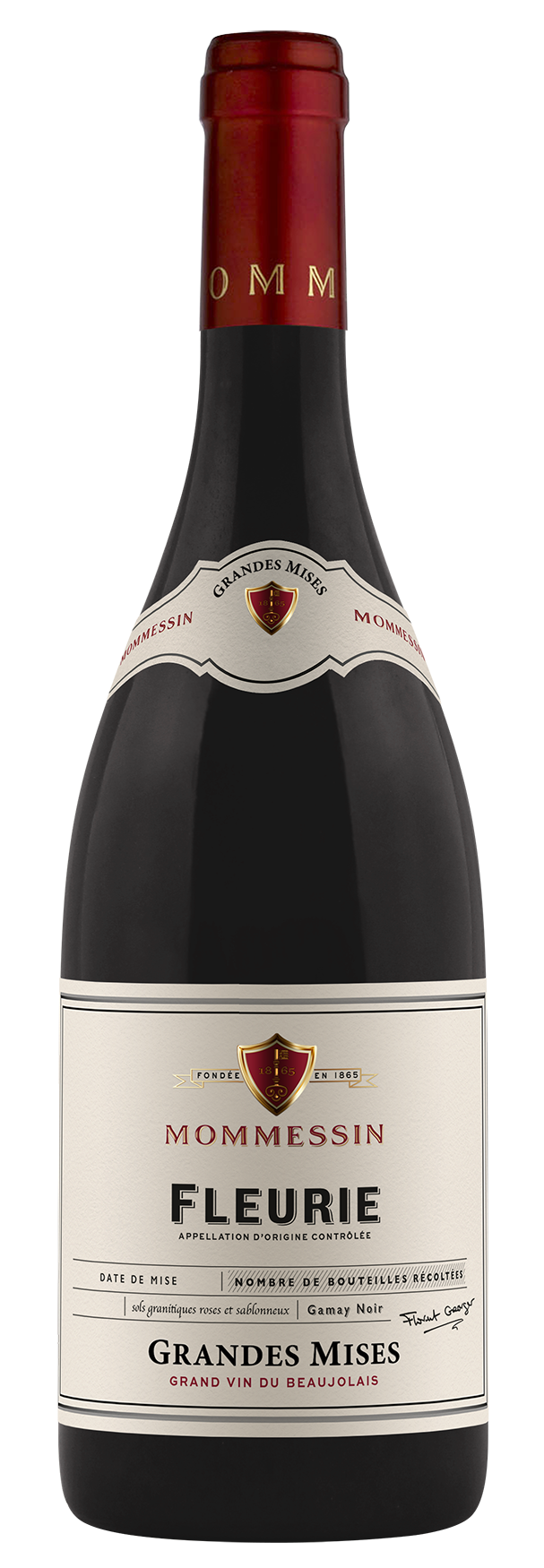
GRANDES MISES
FLEURIE 2024
Grape varietal
Gamay Noir with white juice.
Tasting notes
A fine, fresh and mineral nose with aromas of black cherry and wild strawberry.
On the palate, the wine is elegant, well balanced and complex, with finesse and subtle spice, revealing black fruit flavours. The tannins are silky and the structure generous, with a lovely sense of sweetness.
Serving suggestions
Enjoy this wine slightly below room temperature, between 15 and 18°C. (59-64°F.).
Try carafing this Fleurie to discover all of its richness!
Food and wine pairing
Be daring when pairing this wine with food. It is the perfect accompaniment for fine food as well as traditional regional dishes.
Ageing potential
Fleurie benefits from spending a few years in the cellar without any problem, and up to 8 or 10 if the correct temperature and humidity levels are respected.
Origins
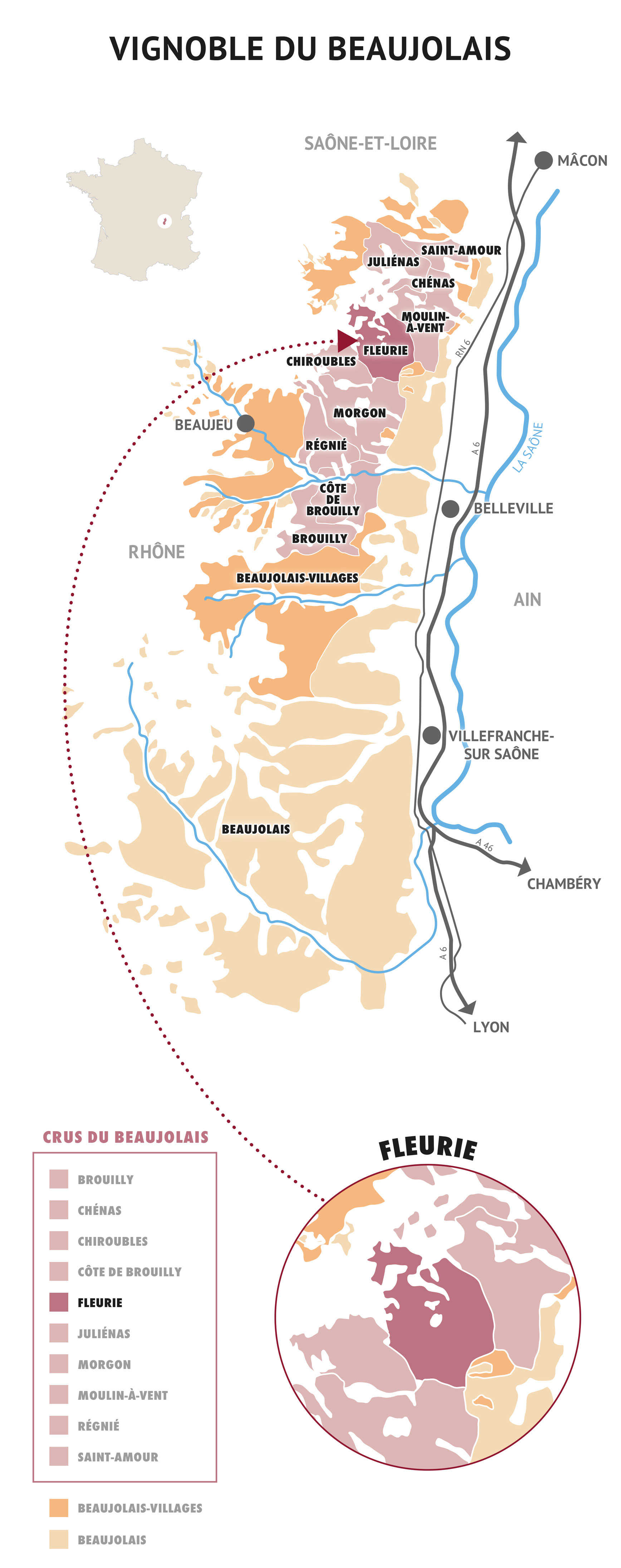
There is proof that vines have been cultivated in Fleurie since 987. Fleurie has been recognized as an AOC since it was granted its appellation by the INAO on 11 September 1936.
This wine takes its name from the village in which it is produced. Legend has it that Fleurie was named after a Roman soldier, Florus, though there are neither architectural nor written traces of the village having been occupied during Roman times.
Fleurie is often considered to be the most feminine of the Beaujolais Crus. Perhaps this is because of the Madonna of Fleurie who, perched at the top of its hill, protectively overlooks the surrounding countryside and vineyards.
Terroir
Fleurie’s pink granite-based terroir gives the wine its intense carmine red colour, along with fruity and floral aromas of iris, violet and rose. The granite features large crystals and typical pinkish-red colour. In some plots there are numerous layers of micro-granite, but, more importantly, other dark or golden mica-rich lamprophyres.
The vineyard’s lowest point is at an altitude of 210m, though the vines grow as high up the slope as 510m. The average altitude is rather high and the slopes are moderate to very steep in most of the appellation, making it one of the Crus with the steepest slopes.
Vine and soil
Age of the vines: 50 years
Yield: 52 hl / ha
The vines are goblet pruned and cultivated with respect for the environment.
Vinification and maturing
The gamay grapes were hand-harvested during the second week of September 2024.
Fermentation without destemming in order to preserve the Gamay’s fresh, juicy and easy-drinking character.
Semi-carbonic maceration in tanks, with cap immersion using grids, lasting 12 to 15 days and alternating pump-overs and rack-and-return, to extract maximum substance and structure and to fix the aromas of the cuvées.
At pressing, the free-run and press juices are blended and racked off for malolactic fermentation and ageing on fine lees.
Vintage : 2024
The winter of 2023-2024 was the 3rd warmest since 1900, with a particularly mild February. Spring was marked by heavy rainfall, with a notable lack of sunshine. Despite these conditions, temperatures remained above normal. Summer alternated between hot and cool spells, with hot spells in July. These climatic variations complicated plant health management in the vineyards, but winegrowers were able to keep the situation under control.
Yields for the 2024 harvest are expected to be low and very heterogeneous, with some plots suffering from coulure and millerandage. The first pruning began in early September. Harvesting was spread over three weeks, finishing at the end of September in the latest-ripening areas.
The reds have notes of raspberry, black cherry, pear and floral scents such as lily of the valley. Initial tastings reveal fruity, elegant, supple wines with a ruby colour. The range of aromas is broad, giving an impression of deliciousness on the palate, with a lovely freshness and pleasant complexity.
Awards
- June 2026 : Bronze Medal - DECANTER World Wine Awards
- April 2026 : 90/100 - STUART PIGOTT
- August 2026 : 90 points - WINE SPECTATOR