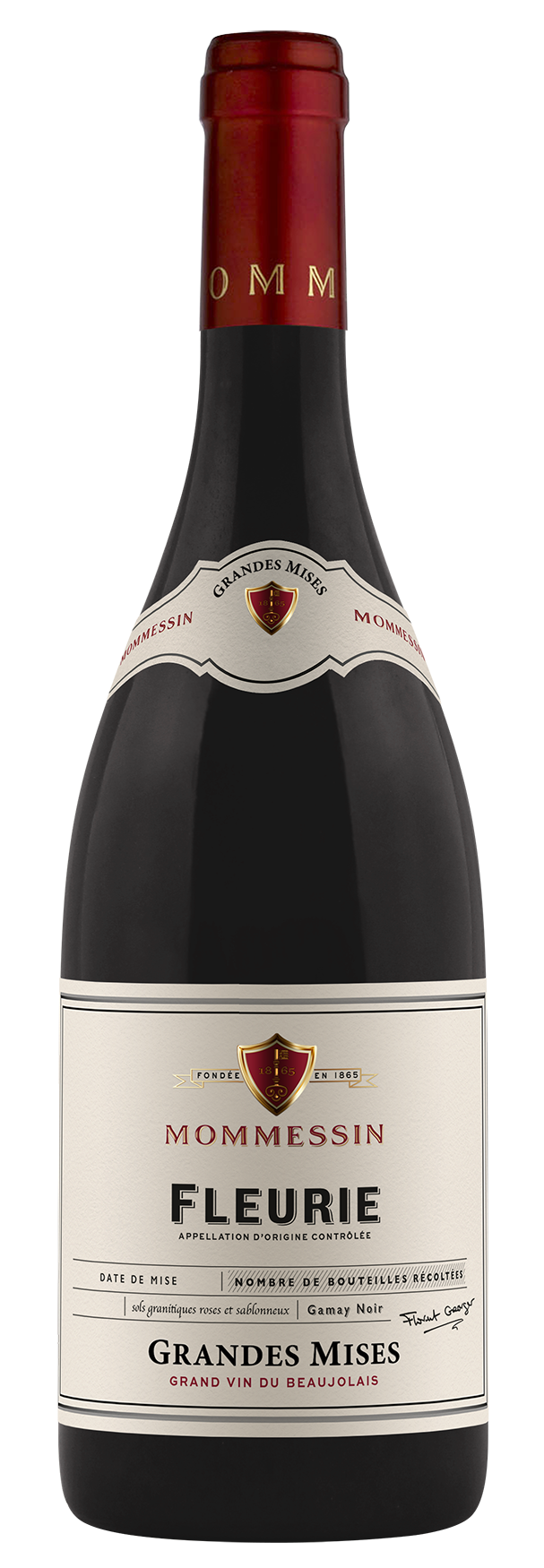
GRANDES MISES
FLEURIE 2025
Grape varietal
Gamay Noir with white juice.
Tasting notes
A refined, fresh and mineral nose, revealing aromas of dark berries.
The palate is elegant, well-balanced, creamy, complex and spicy, with silky tannins. The structure is generous, supported by a pleasing richness and a long, harmonious finish.
Serving suggestions
Enjoy this wine slightly below room temperature, between 15 and 18°C. (59-64°F.).
Try carafing this Fleurie to discover all of its richness!
Food and wine pairing
Be daring when pairing this wine with food. It is the perfect accompaniment for fine food as well as traditional regional dishes.
Ageing potential
Fleurie benefits from spending a few years in the cellar without any problem, and up to 8 or 10 if the correct temperature and humidity levels are respected.
Origins
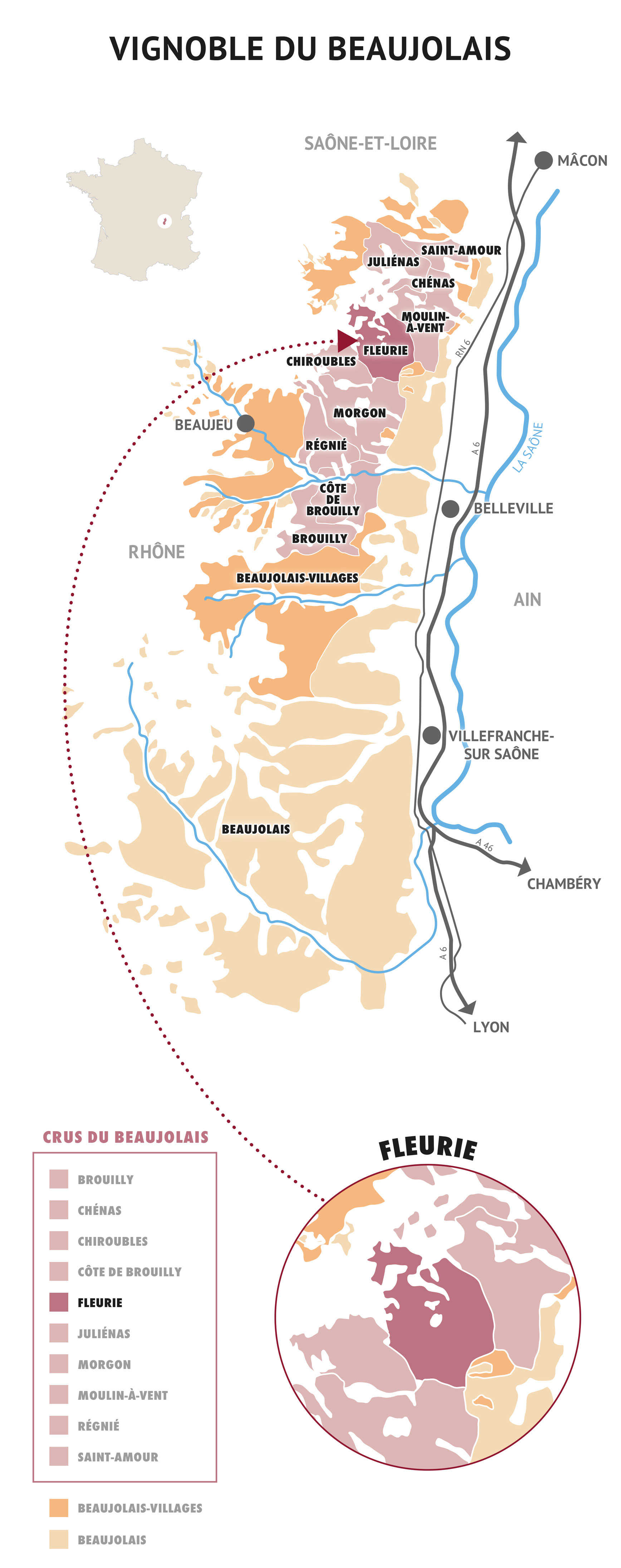
There is proof that vines have been cultivated in Fleurie since 987. Fleurie has been recognized as an AOC since it was granted its appellation by the INAO on 11 September 1936.
This wine takes its name from the village in which it is produced. Legend has it that Fleurie was named after a Roman soldier, Florus, though there are neither architectural nor written traces of the village having been occupied during Roman times.
Fleurie is often considered to be the most feminine of the Beaujolais Crus. Perhaps this is because of the Madonna of Fleurie who, perched at the top of its hill, protectively overlooks the surrounding countryside and vineyards.
Terroir
Fleurie’s pink granite-based terroir gives the wine its intense carmine red colour, along with fruity and floral aromas of iris, violet and rose. The granite features large crystals and typical pinkish-red colour. In some plots there are numerous layers of micro-granite, but, more importantly, other dark or golden mica-rich lamprophyres.
The vineyard’s lowest point is at an altitude of 210m, though the vines grow as high up the slope as 510m. The average altitude is rather high and the slopes are moderate to very steep in most of the appellation, making it one of the Crus with the steepest slopes.
Vine and soil
Age of the vines: 50 years
Yield: 52 hl / ha
The vines are goblet pruned and cultivated with respect for the environment.
Vinification and maturing
Whole-cluster fermentation to preserve the Gamay grape’s charming, juicy, and easy-drinking character.
Semi-carbonic maceration in tanks, with cap immersion using grids, for 12–15 days, alternating pump-overs and rack-and-return operations to extract maximum body and structure while enhancing and stabilizing the wines’ aromas.
After pressing, free-run and press juices are blended and racked for malolactic fermentation and aging on fine lees, including 20% in oak barrels.
Vintage : 2025
In the Beaujolais area, the 2025 vintage stands out for its remarkable precocity, in line with great sunny years such as 2015 and 2018. After a fairly cool winter and a balanced spring, budbreak occurred as early as April 6, followed by a rapid flowering at the end of May, eight days ahead of 2024.
Early summer was marked by contrasts: heavy rainfall in early June, locally accompanied by hail, was followed by a sharp rise in temperatures. A more moderate July preceded a heatwave in August, with peaks above 40°C. (104° F.), leading to significant water stress.
These conditions accelerated ripening, enhanced berry concentration and kept disease pressure extremely low. Harvest began on August 23 for Chardonnay and August 25 for Gamay, extending until September 16 depending on the area.
Despite reduced volumes due to hail and drought, quality is definitely there: concentrated, complex wines with deep color and solid tannic structure. A truly nice vintage in the making.