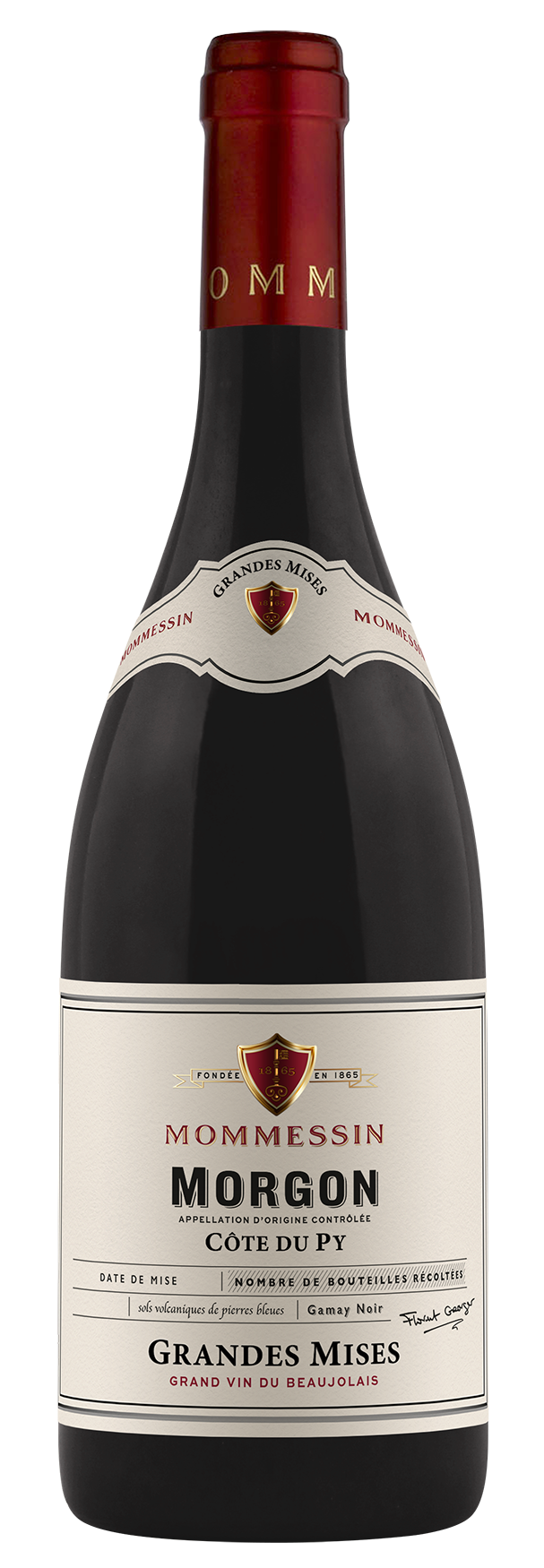
GRANDES MISES
MORGON
CÔTE DU PY 2025
MORGON
CÔTE DU PY 2025
Grape varietal
Black Gamay with white juice.
Tasting notes
Beautiful ruby colour with purple highlights. The nose is marked by black fruits, enhanced by kirsch and spicy notes. The palate seduces with its pure minerality and silky, elegant tannins, ending with a beautiful length.
Serving suggestions
Best served at a temparatur of about 15°C to 18°C. (59-64°F.)
Food and wine pairing
Morgon « Côte du Py » pairs well with duck and feathered game dishes. It would also match with rippened cheeses full of character.
Let be amazed by decanting this astonishing wine!
Ageing potential
Morgon « Côte de Py » has a tremendous ageing potential: This well-balanced wine can age up to 10 years, with correct temperature and humidity conditions.
Origins
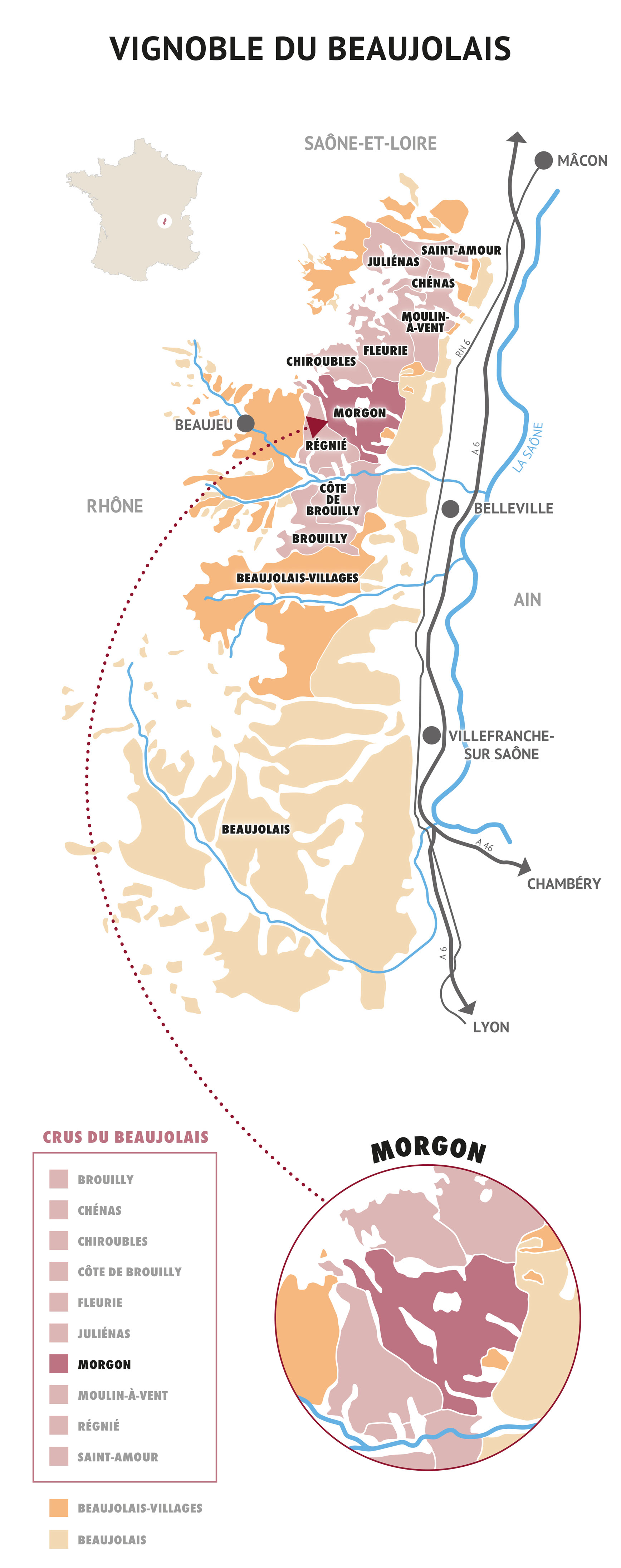
From the 10th Century onwards, we find traces of vineyards in Morgon. An act dated 956 A.D.shows the sale of a vineyard by the Sire de Beaujeu to a local vassal. Morgon is one of the 10 crus of the Beaujolais. The vineyard is situated on hills west of the Saône river, in the heart of the crus in the northern part of the region. (50 Km north of Lyon, 25 km north of Villefranche and 25 km south of Mâcon) and stretches over 1,100 hectares.
Terroir
A special terroir made up of decomposed rocks and brittle schists, Morgon is split between 6 distinct climats - Les Micouds, Corcelette, Douby, Les Grands Cras, Les Charmes and the most famous “Côte du Py”.
Formed by the weathering of brittle crystalline rocks, essentially pyritic schists, rich in iron-oxide and a little manganese, the soil is made up by irregular-shaped rocks, thus containing more or less clay. What is known as “roche pourrie” or “morgon” is a very-advanced form of schists and very old volcanic rocks. The Py hillside, which culminates at 352 metres gives the best terroirs with fine layers of volcanic, schistous rocks rich in manganese and iron.
Vine and soil
Soil: very deep and drains easily, ideal conditions for the Gamay grape whatever the weather
Vineyard age: between 35 and 55 years old.
Yield: 56 hectoliters per hectar
3 hectars divided in 4 plots have been selected with the partner-grower.
Oriented south and south-west with a slope often greater than 30%.
The vines are pruned « en gobelet » and « en cordon-de-Royat ». They are managed with substainable farming methods
Vinification and maturing
The grapes were harvested by hand in early September 2025.
Upon receipt of the grapes at our partner winegrowers' premises, the vinification process began for this Beaujolais vintage:
- 80% of the grapes were destemmed but not crushed, then transferred to vats by gravity.
- Maceration lasted 15-18 days with punching down, pumping over and racking.
- The temperature was maintained at 25°C to extract colour and preserve the fruitiness of the Gamay.
- 25% of the cuvée was then transferred to French Burgundy barrels (225L), used for 1 to 3 wines, mainly from the Tronçais forest (Allier), with medium toasting so as not to overpower the wine. This brings the roasted notes, sweetness and roundness necessary to showcase this terroir. The wine is aged on fine lees for 9 months.
- Bottled after light filtration: 16,140 bottles harvested.
Vintage : 2025
In the Beaujolais area, the 2025 vintage stands out for its remarkable precocity, in line with great sunny years such as 2015 and 2018. After a fairly cool winter and a balanced spring, budbreak occurred as early as April 6, followed by a rapid flowering at the end of May, eight days ahead of 2024.
Early summer was marked by contrasts: heavy rainfall in early June, locally accompanied by hail, was followed by a sharp rise in temperatures. A more moderate July preceded a heatwave in August, with peaks above 40°C. (104° F.), leading to significant water stress.
These conditions accelerated ripening, enhanced berry concentration and kept disease pressure extremely low. Harvest began on August 23 for Chardonnay and August 25 for Gamay, extending until September 16 depending on the area.
Despite reduced volumes due to hail and drought, quality is definitely there: concentrated, complex wines with deep color and solid tannic structure. A truly nice vintage in the making.